
Mali’s junta in crisis as rebels seize towns and military bases after killing defence chief
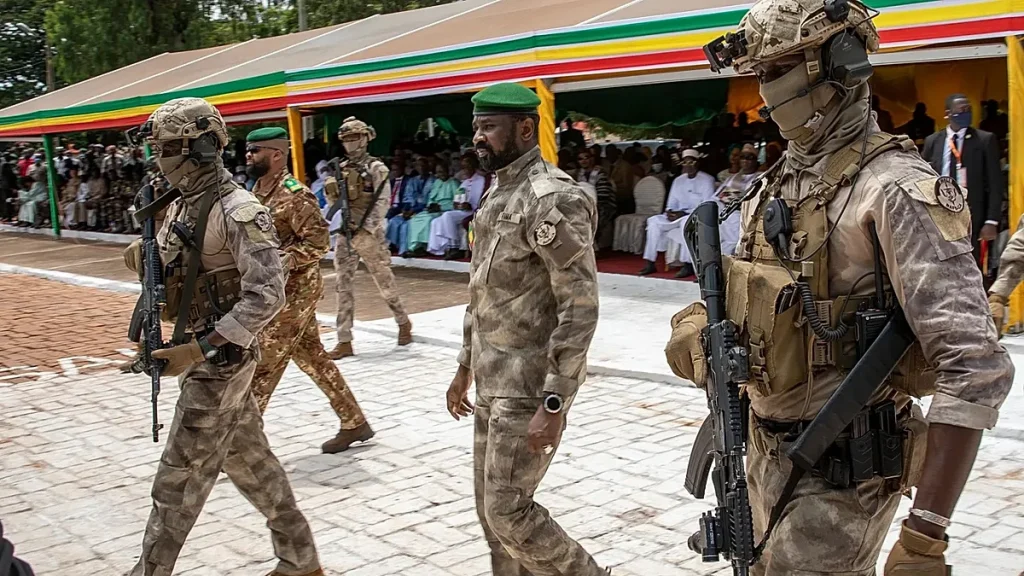
Mali’s Junta Under Threat: Rebels and Jihadists Spark Chaos After Targeting Defense Chief
Mali’s military rulers are grappling with escalating tensions following the killing of Gen. Sadio Camara, the nation’s defense minister, in a coordinated assault by rebels and jihadist groups on Saturday. This incident marks the latest chapter in a protracted conflict that has plagued the junta-led country, where militants linked to al-Qaida and Islamic State have frequently clashed with government forces, alongside a separatist movement in the north.
Authorities confirmed Camara’s death via a Facebook post from the defense ministry and a state television broadcast by Gen. Issa Ousmane Coulibaly, the government’s spokesperson. According to the statement, Camara’s home was attacked by a suicide car bomber and other assailants. He returned fire, managing to eliminate some attackers before being severely injured during fierce combat. Despite medical efforts, he passed away in the hospital from his wounds.
The attacks, which targeted Bamako and multiple other cities, also disrupted the security alliance between Mali and Russia. Russian troops, stationed in the West African nation, were forced to retreat from Kidal after agreeing to a peaceful withdrawal with the separatist Azawad Liberation Front, or FLA. “Kidal is declared free,” said FLA representative Mohamed El Maouloud Ramadan, adding that the operation was conducted in partnership with the al-Qaida-linked JNIM group.
A Coordinated Assault on Security Forces
On Saturday, rebels launched one of the largest coordinated strikes on Mali’s military, impacting the capital and several towns. The assault not only challenged the government’s control but also tested its partnership with Russian mercenaries, who had been deployed to support security operations. Coulibaly noted that 16 individuals, including civilians and military personnel, were injured, while some militants were eliminated.
Following the attacks, a three-day curfew was imposed in Bamako’s district, restricting movement from 9 p.m. to 6 a.m. The Economic Community of West African States (ECOWAS) denounced the violence, urging regional cooperation to combat the growing threat. The separatists, who have long sought independence in northern Mali, cited Russia’s support for the junta as a factor in civilian suffering, calling for its reconsideration.
Historical Context and Regional Shifts
For years, the Tuareg-led FLA has fought to establish an autonomous state in the north, a struggle that intensified after Kidal was captured by government forces and Russian allies in 2023. This victory was seen as a symbolic triumph for the junta, but the recent attacks suggest the rebellion’s persistence. The conflict has also seen a shift in regional alliances, with Mali, Niger, and Burkina Faso turning to Russia after military coups, despite rising numbers of militant attacks.
Government troops have faced accusations of targeting civilians suspected of aiding rebels, further complicating the security situation. As the junta confronts internal and external pressures, the fate of Kidal and the broader region remains uncertain, with tensions between rebel groups and the military continuing to escalate.

