
Striking souvenir from 2nd century AD Hadrian’s Wall in UK found in Spain
Striking souvenir from 2nd century AD Hadrian’s Wall in UK found in Spain
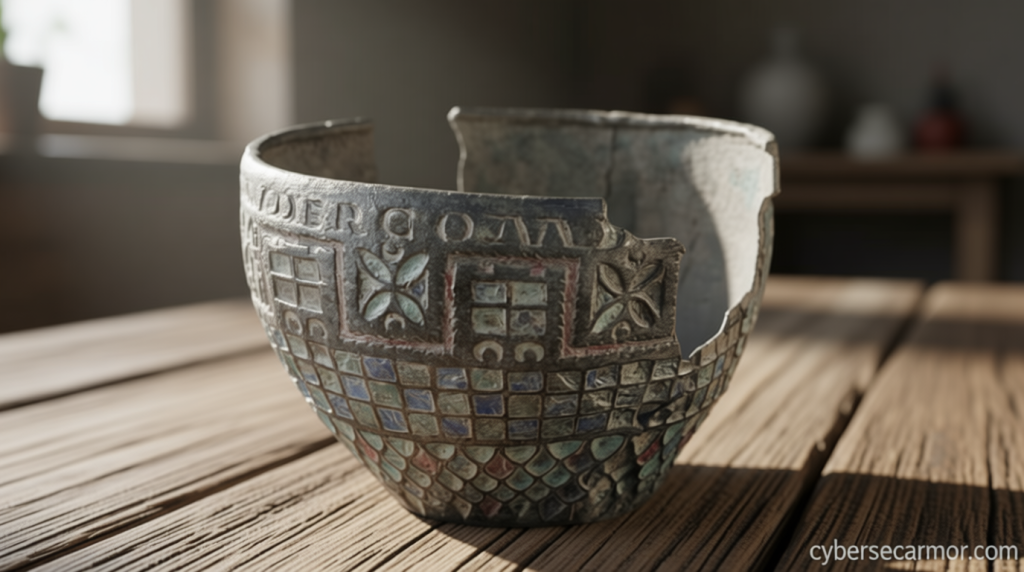
A Roman soldier from Celtiberian heritage completed his service at the Empire’s northernmost frontier and embarked on a lengthy journey home to the regions now known as the Castilian-Leonese province of Soria in Spain. Among his belongings was not just a collection of mementos, but a small, intricately decorated bronze cup with enamel details. This artifact, discovered centuries later in Berlanga del Duero, has now become the focus of a groundbreaking study published in Britannia, led by researchers from the Consejo Superior de Investigaciones Científicas (CSIC) and the Museo Arqueológico Nacional.
Historical Significance of Hadrian’s Wall
Hadrian’s Wall, a 117km defensive structure built between 122 AD and 128 AD, remains one of antiquity’s most iconic feats. Commissioned by Emperor Hadrian, it was designed to shield the Roman province of Britain from incursions by the Picts, the indigenous inhabitants of the northern isles. While its military function is well-documented, a lesser-known aspect is the existence of commemorative bowls associated with this boundary.
Commemorative Artifacts and Their Origins
These bowls, crafted from bronze and adorned with enamel, depicted the Wall through a series of turrets in a frieze-like pattern. The names of forts were engraved along the rim, offering a tangible link to Roman military presence. Until now, five such pieces had been identified globally, along with two fragments. Earlier discoveries, including the 1725 find in Rudge Coppice, England, and subsequent finds in France and the Iberian Peninsula, highlighted the western-central forts of the Wall.
The cup found in Berlanga del Duero stands apart. It is the only artifact in the series that features inscriptions from the eastern sector, including Cilurnum (modern Chesters, Northumberland), Onno (Halton Chesters), Vindobala (Rudchester), and Condercom (Benwell). These names, absent in previous cups, provide new insight into the Roman Empire’s reach and the structure of its frontier defenses.
“This constitutes an unprecedented reading of the orientation of these commemorative cups,” noted the research team, emphasizing the unique arrangement of the inscriptions. The names are ordered from west to east, as if viewed from the Roman side of the Wall, offering a fresh perspective on the artifact’s purpose and design.
Despite being fractured and deformed, the Berlanga cup retains between 80-90% of its original volume. This allowed for a near-perfect reconstruction using digital techniques. The team created a 3D model through photogrammetry with Agisoft Metashape software, revealing precise dimensions: 11.34 cm at the mouth, 4.95 cm at the base, and 7.89 cm in height. These measurements place it as the largest of its kind, surpassing other notable examples by over three centimeters.
The cup’s design is equally remarkable. Three horizontal enamel bands in red, green, turquoise, and navy blue replicate the Wall’s profile, complete with crenellated turrets. Its Latin inscription, etched in 5.5-millimetre letters filled with glass paste, adds to its visual and historical intrigue. Further analysis using portable X-ray fluorescence spectrometry and lead isotope studies at Durham University’s geochemistry lab confirmed its composition as a zinc-lead bronze alloy, common in 2nd-century AD Britannia.
Isotopic data, processed via the AMALIA algorithm, suggests the metal originated from mines in northern England or Wales, particularly those in the North Pennines, Durham, or Welsh regions. This aligns with the hypothesis of local production in Britain, given the proximity of these mining areas to Hadrian’s Wall. The study not only redefines the cup’s origins but also expands the understanding of Roman craftsmanship and distribution networks across the Empire.

