
Former South Korean President Yoon Suk Yeol handed life sentence for leading insurrection
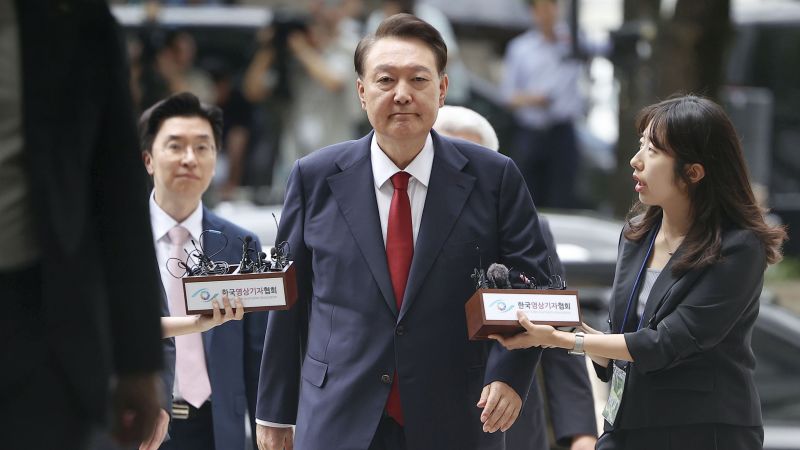
Former South Korean President Yoon Suk Yeol Receives Life Sentence for Leading Insurrection
On Thursday, the former South Korean president, Yoon Suk Yeol, was handed a life sentence following a court ruling that convicted him of orchestrating an insurrection. The charge stemmed from his brief imposition of martial law in December 2024, which triggered political turmoil and raised concerns about the stability of the nation’s democratic system.
Yoon, 65, announced martial law in a televised address on December 3, 2024, citing “anti-state forces” within opposition parties that he claimed were aligned with North Korea. The move led to military troops arriving at the parliament by helicopter and attempting to seize control of the legislative chamber. As chaos unfolded, citizens, lawmakers, and staff rushed to secure the building’s entrances, creating tense scenes broadcast live across the country.
Presiding judge Ji Gwi-yeon emphasized that Yoon’s actions were aimed at significantly disrupting the National Assembly. The judge pointed to the language in the military decree and the effort to detain political figures, including the leader of the opposition Democratic Party and a senior member of Yoon’s own ruling party, as clear evidence of intent to destabilize the democratic process.
The court also found former defense minister Kim Yong-hyun guilty of a key role in the insurrection, sentencing him to 30 years in prison. Four other military and police officials received sentences ranging from 3 to 18 years. Yoon’s legal team challenged the ruling, arguing procedural errors and inconsistencies in the charge.
“You may be able to deceive the public for a while and draw cheers in the public square, but the truth will one day be revealed in the court of history. We will never yield to distortion and lies, and we will fight to the very end,”
Yoon’s supporters gathered outside the Seoul Central District Court, watching the proceedings on a large screen. His defense claimed that the martial law was intended to highlight political gridlock caused by the opposition’s majority in the National Assembly and their impeachment of top officials. “The National Assembly brought about the national crisis and there was no other way but to awaken the people,” he stated in closing arguments, asserting that his actions were a constitutional response.
Cho Kuk, leader of the Rebuilding Korea Party, criticized Yoon’s actions as an attempt to dismantle the country’s democratic foundations. “There are many places where democracy is faltering,” he added. “South Korea’s experience shows that the power to protect and recover democracy lies within the people.”
Song Hwa, a citizen who joined the National Assembly on December 3 with her husband after Yoon’s declaration, hailed the verdict as “an extremely important decision” that would “send a powerful message to the public.” The ruling marks a significant moment in South Korea’s ongoing political evolution, a nation that has long been a model of democratic resilience.
