Why this photographer’s 9/11 ‘Falling Man’ photo remains controversial

Daftar Isi
The Man Who Fell: How One Frame Became 9/11’s Most Unsettling Legacy
Cybersecarmor.com – Twenty-five years after the twin towers came down, a single photograph still stops conversations cold. It shows a man in freefall, body aligned with the steel columns of the World Trade Center, one knee bent in what looks almost like relaxation. Around him, smoke billows and debris rains. The image, captured at 9:41 a.m. on September 11, 2001, has become so embedded in the national memory that it now functions less as a news photograph and more as a cultural wound — one that refuses to heal.
The man’s identity was never confirmed. That anonymity, combined with the photo’s publication in major outlets, ignited a decades-long argument over whether he chose to jump, whether he was pushed by smoke, and whether publishing his final seconds constituted an act of respect or of violation. At the National September 11 Memorial Museum in Lower Manhattan, the image is not hung on a wall. It appears only as a brief projection in a recessed alcove, visible for a few seconds before fading — a curatorial decision that speaks volumes about how the institution handles the photograph’s emotional charge.
A Routine Morning, Interrupted
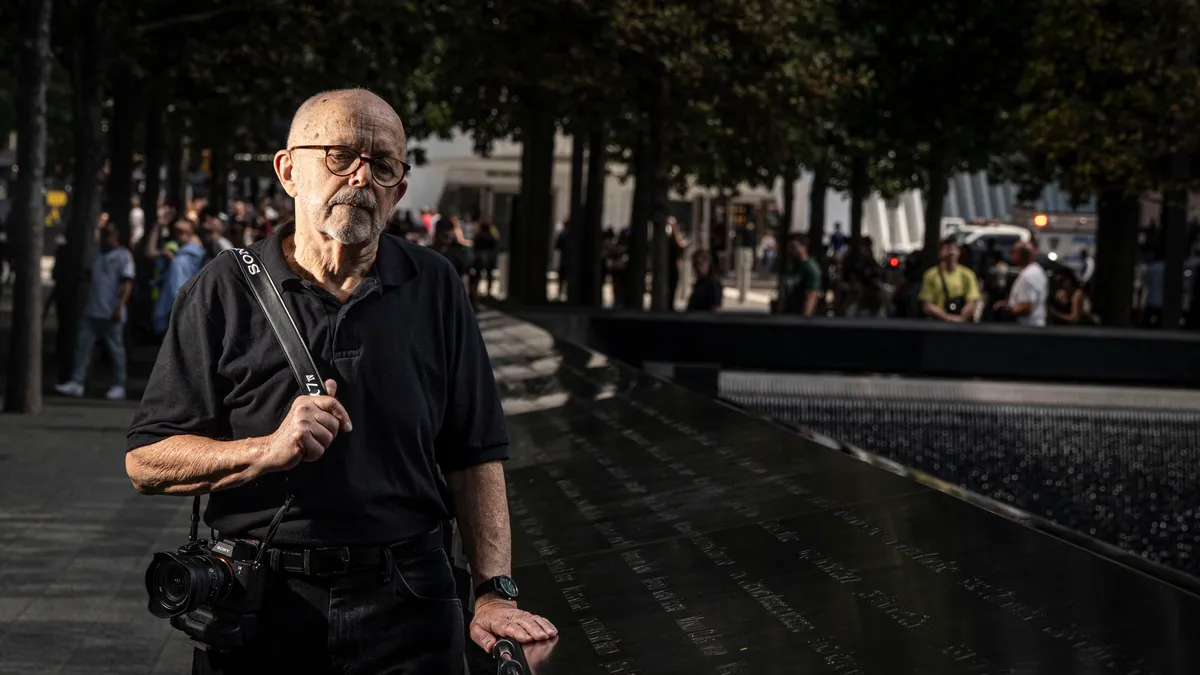
Richard Drew, an Associated Press photographer who had already earned a Pulitzer Prize and had been close enough to shoot Robert F. Kennedy’s assassination to be splattered by blood, was not at the World Trade Center that morning. He was in Bryant Park, Midtown Manhattan, roughly 3.5 miles from the towers, set up to photograph a maternity fashion show. A standard assignment for a veteran who had spent decades chasing singular, decisive moments.
The assignment ended the instant a CNN cameraman working beside the runway pressed a finger to his earpiece and repeated, aloud, what his newsroom was feeding him:
“A plane’s hit the World Trade Center.”
Drew’s own phone rang moments later. His editor’s instruction was blunt: abandon the fashion show and get to the scene. Drew sprinted to Times Square, caught a subway car to Chambers Street — one stop short of the complex — and emerged into a street already choked with smoke and wailing sirens. By then, a second jet had struck the south tower. Both buildings were engulfed.
The 102 Minutes
In the north tower, workers above the 91st floor found themselves sealed in by fire and smoke that had consumed every stairwell and exit. Crowds pressed against shattered windows, breathing thin air, watching the streets below. What they saw falling was not only glass and steel. Witnesses on the ground realized, with growing horror, that people were among the debris.
An emergency medical worker standing nearby pointed upward and said, as Drew later recalled:
“Look at that.”
One Morgan Stanley employee on the 72nd floor of the south tower described watching a woman drop with her back toward the pavement, landing flat, eyes fixed upward in a mask of shock. Others clutched drapes they had hoped would slow their descent. A couple reportedly held hands before releasing the ledge together. A woman in a business suit grabbed her skirt as she stepped off. Each fall lasted roughly ten seconds, terminal velocity approaching 150 miles per hour.
In the 102 minutes between the first impact and the total collapse of both towers, as many as 200 people jumped or fell from the upper floors. Most came from the north tower. Many were driven out not by flame but by dense, superheated smoke that made breathing impossible. Police helicopter pilots hovering within sight of the towers could do nothing but watch. Bystanders on Vesey Street and West Street looked up, helpless.
The Frame That Would Not Be Forgotten
Drew, positioned at the intersection of West and Vesey streets, was photographing the burning structures when his 200mm zoom lens found a single figure in midair. He fired a burst of frames. One of those frames showed the man perfectly vertical, parallel to the towers’ structural columns, his posture suggesting a composure that clashed violently with the inferno surrounding him.
The photograph ran. And then the backlash came. Readers wrote letters demanding the image be pulled. Families of victims objected. Religious communities raised questions about showing a soul in transit. The photograph became, in the words of one commentator, a taboo — an image so painful that its mere presence in a magazine felt like an intrusion.
Tom Junod, who wrote a long-form essay about the photograph for Esquire in 2003 and helped cement its reputation as the “unknown soldier” of September 11, described the polarized response in recent conversation:
“You have people saying, ‘I read this story every year, I look at this photo every year, I think of the falling man every year.’ And then you have people saying, ‘Every year I am accosted by this horror. Please make it stop.'”
What the Image Asks of Us
The photograph endures because it forces a question no viewer can deflect: What would I have done? Not what would a hero do, not what would a coward do, but what would I do, standing at a window with smoke filling the corridor behind me and a hundred feet of open air below? The ambiguity of that question — whether the man chose, whether he was forced, whether the distinction even matters at terminal velocity — is precisely what keeps the image alive in debate.
The search for his identity has been complicated by grief, by religious sensitivities about identifying the dead, and by the simple fact that no one on the ground could confirm a name. Families of men who were on upper floors have been approached, asked, and sometimes asked again. The question of who he was has, in many ways, become less important than the question of what his image does to the person looking at it.
Drew, now a veteran of more than four decades behind a camera, has spoken about the weight of carrying that single frame through every anniversary since. The photograph defined, for millions of Americans who were not in New York that morning, the human cost of a day they experienced only through television. It made the abstract number — 2,977 — into a face, a posture, a split second of gravity doing its work. Whether that transformation is an act of witness or an act of exposure remains, twenty-five years on, the most challenging question the image poses.
Related Reading
Frequently Asked Questions
What is Why this photographer s 9 11 Falling?
Why this photographer s 9 11 Falling is the main topic of this guide. The article explains the context, practical details, and next steps readers should understand.
Why does Why this photographer s 9 11 Falling matter?
Why this photographer s 9 11 Falling matters because readers are looking for a useful answer, not just a short summary. Good content should match search intent and help them decide what to do next.