Hurricane Lowell passes near Hawaii, brings threats of rain, tornadoes

Daftar Isi
Hurricane Lowell Skirts Hawaii, Unleashing Storm-Surge Winds and Record Rainfall Threats Across the Islands
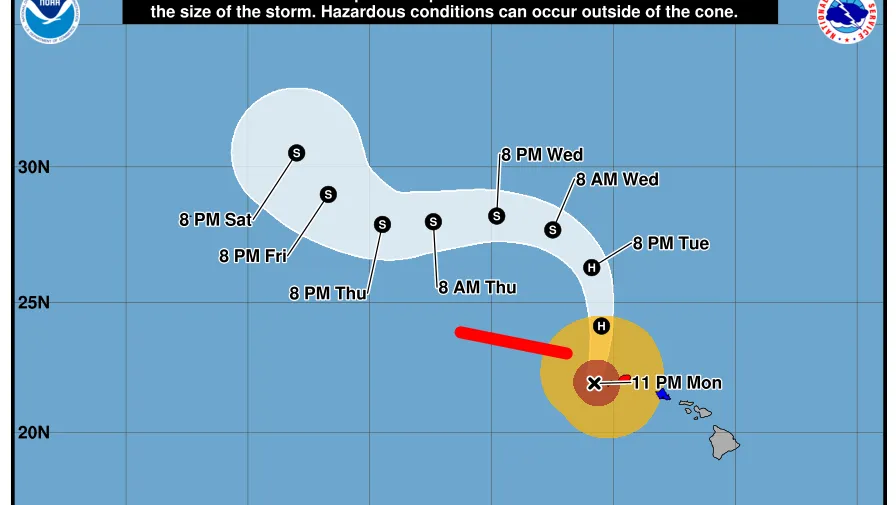
Cybersecarmor.com – Early on September 8, a Category 2 hurricane threaded its outer bands through the Hawaiian archipelago without making direct landfall, yet the proximity alone was enough to trigger hurricane-force gusts, torrential downpours, and a credible tornado risk for residents of the western islands. Hurricane Lowell, packing maximum sustained winds of 105 mph, tracked northward at roughly 18 mph while its core sat north-northwest of Niihau at 2 a.m. Hawaii time (8 a.m. ET), placing Kauai County squarely in the storm’s most violent quadrant.
Hawaii sits in a region of the central North Pacific where hurricanes are comparatively rare, which means infrastructure, building codes, and public preparedness are calibrated for tropical storms rather than full-strength hurricanes. When a storm of Lowell’s intensity passes within a few hundred miles of the islands, even without a direct hit, the resulting wind shear, rain bands, and ocean swell can overwhelm systems designed for lesser threats.
Warnings and Watches in Effect
The National Hurricane Center maintained a hurricane warning over Kauai County, encompassing both Kauai and the small island of Niihau roughly 17 miles to the southwest. Hurricane conditions had already taken hold on the afternoon of September 7. Oahu, home to the majority of the state’s population, carried a tropical storm warning. Separately, the National Weather Service in Honolulu issued a tornado watch covering portions of Kauai through 4 a.m. Hawaii time, a rare designation for the islands that signals forecasters expected rotating updrafts capable of producing multiple tornadoes near Kauai and Niihau overnight.
Mayor’s Message to Residents
“I hope you have spent these last few days preparing for the worst,” Kauai County Mayor Derek Kawakami told residents in a public message.
Kawakami also noted that the storm was “too close for comfort,” underscoring that forecasters had warned impacts could be severe regardless of whether the eye ever crossed the coastline. Residents in flood-prone valleys and low-lying coastal zones were directed to relocate to higher ground or designated refuge areas. Emergency managers cautioned that power outages, road closures, and interruptions to municipal water service were likely as the system moved past the state.
Damage Already Reported Across Kauai
By Labor Day morning, the Hanalei Bridge on Kauai’s north shore was shut down after floodwaters overtopped the roadway. Multiple waterways across the island surged six to eight feet above normal levels during the heaviest rainfall. In the town of Kilauea, a falling tree struck a residence and injured one occupant, per the weather service. On the south coast in Poipu, a house was torn from its foundation and deposited into an adjacent yard. At least one resort in Poipu saw the ocean surge directly into its swimming pool, encircle the structure, and inundate the neighboring road, carrying parked vehicles away from their spots. In Kawaihau, emergency managers confirmed a roof had been peeled entirely off a home.
Social-media posts from state and local officials documented numerous road closures across the island chain, attributed to the combination of heavy rain and surging surf.
Wind Measurements
Barking Sands, a coastal site on western Kauai, recorded sustained winds of 51 mph with a peak gust of 84 mph. Lihue Airport, situated along the island’s southeastern coast, logged sustained winds of 53 mph and a gust reaching 79 mph. Both readings confirm that hurricane-force conditions touched down on Kauai despite the storm’s center remaining offshore.
Rainfall Forecasts
The National Hurricane Center projected an additional four to eight inches of rain for Kauai, with maximum storm totals reaching 24 inches. The Big Island faced three to eight additional inches, with isolated totals of 12 inches possible. Oahu and Maui County were expected to receive two to five additional inches, with isolated peaks of 10 inches. Forecasters emphasized that such rainfall totals on Kauai’s steep, volcanic terrain carry a high risk of flash flooding and landslides, particularly in the island’s interior valleys where drainage is limited and soils are already saturated.
What Comes Next
As of 2 a.m. Hawaii time on September 8, Lowell sat approximately 110 miles northwest of Lihue and 215 miles west-northwest of Honolulu. The storm was expected to maintain its northward speed through the day before curving toward the northwest and west, gradually weakening over the following couple of days as it moved into cooler waters and stronger upper-level flow.
Emergency Guidance for Residents
Officials reiterated that motorists should not attempt to drive through flooded roadways, a leading cause of storm-related fatalities in island communities. Kauai County urged residents to anticipate interruptions to essential services and to conserve water. The county Department of Water issued a conservation notice asking customers to limit use to essential needs, warning that storm-related power outages could impair pumps and wells, reducing pressure or halting service entirely. Residents were advised to store drinking water and fill containers for sanitation in advance.
County officials also asked the public to reserve 911 lines for life-threatening emergencies rather than calling for weather updates or road-condition inquiries, ensuring dispatch capacity remained available for true crises.
Kauai, home to roughly 73,000 residents, and the sparsely populated island of Niihau both faced the full brunt of Lowell’s high winds. For many islanders, the experience marked one of the most intense hurricane-adjacent events in recent memory, a reminder that even a storm that never touches shore can reshape the landscape within hours.
Related Reading
Frequently Asked Questions
What is Hurricane Lowell passes near Hawaii brings?
Hurricane Lowell passes near Hawaii brings is the main topic of this guide. The article explains the context, practical details, and next steps readers should understand.
Why does Hurricane Lowell passes near Hawaii brings matter?
Hurricane Lowell passes near Hawaii brings matters because readers are looking for a useful answer, not just a short summary. Good content should match search intent and help them decide what to do next.