Trump posts map renaming New Mexico to ‘New America’

Daftar Isi
Trump’s Latest Renaming Gambit Targets New Mexico
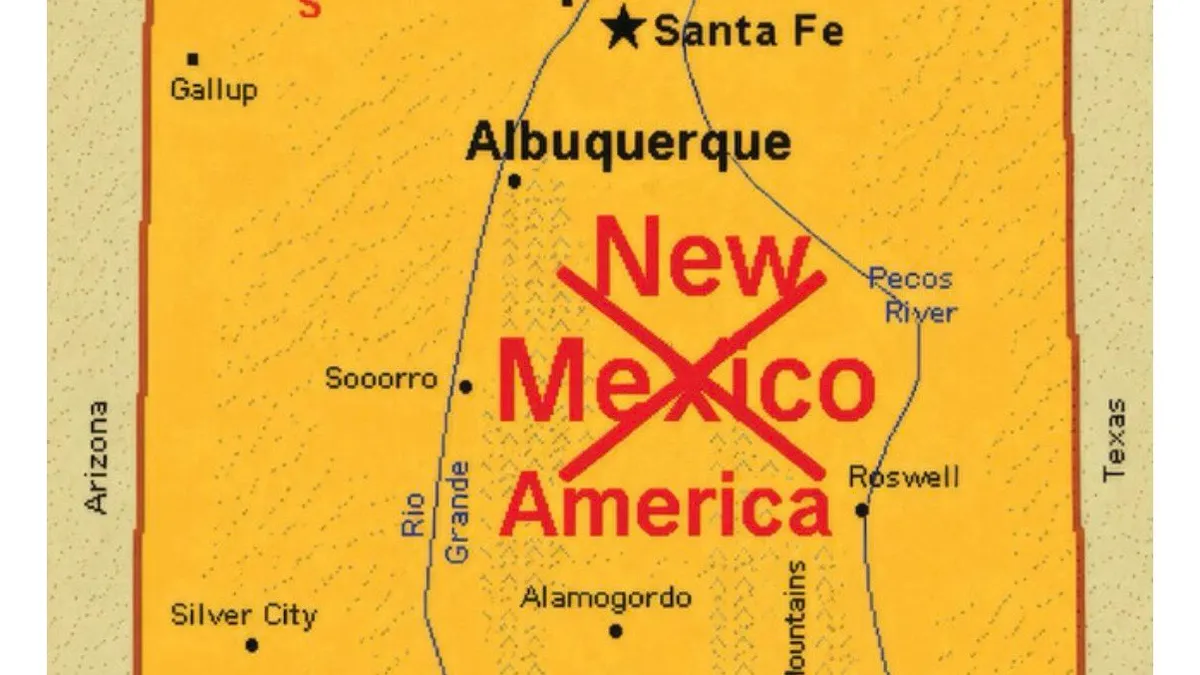
Cybersecarmor.com – On a Labor Day weekend in early September, President Donald Trump added another entry to his already extensive catalogue of geographic name changes, this time aiming squarely at the American Southwest. An image circulated showing the state’s outline with the word “Mexico” struck through and “America” substituted in its place, effectively proposing that the state be called “New America.” The White House account amplified the post on Sept. 6, pushing it to millions of followers during the three-day federal holiday.
The president followed up with an artificial intelligence–generated clip on Truth Social in which he is shown physically slapping the word “America” onto a highway sign welcoming drivers into the state, then breaking into a celebratory dance set to the Village People’s “Y.M.C.A.”
“Many people suggested changing the name of New Mexico, one of the great vote cheating states of all time, to NEW AMERICA. So much more prestigious and beautiful for the people of that potentially incredible State,” Trump wrote alongside the video.
A Pattern of Renaming
The New Mexico proposal is the newest chapter in a renaming campaign that has spanned oceans, lakes, and federal institutions. Earlier in his second term, the 80-year-old president rebranded the Gulf of Mexico as the “Gulf of America,” swapped “Ontario” for “America” in the name of Lake Ontario, renamed the Strait of Hormuz the “Trump Strait,” and appended his surname to the John F. Kennedy Center for the Performing Arts in Washington, D.C. Each change has drawn swift pushback from state governments, foreign partners, and the general public.
New Mexico’s Political Response
State politicians moved quickly to push back. Deb Haaland, the Democratic candidate for governor and former U.S. Secretary of the Interior — the first Native American to hold a Cabinet post — took to X to declare:
“You can’t be serious. New Mexico is not for renaming. Not up for sale. My promise: I’ll always stand up for what makes New Mexico, New Mexico.”
U.S. Rep. Gabe Vasquez, representing Las Cruces, fired back directly at the president:
“You don’t get to erase New Mexico. Not our name. Not our history. Not our culture. The President may want to call us ‘New America,’ but we know who we are.”
Both of the state’s senators joined the chorus. Sen. Martin Heinrich posted a list titled “Three things I will always call by their actual names…” followed by the Gulf of Mexico, Lake Ontario, and New Mexico. Sen. Ben Ray Luján went further, writing:
“It’s New Mexico, always has been and always will be. Just like how you’ll always be a sinvergüenza and corrupt.”
Gov. Michelle Lujan Grisham framed the episode as a distraction tactic, asserting that the state’s “name isn’t up for debate” and adding that “While the White House wastes time coloring on maps, Nuevo México is busy doing the work.”
“While the President tries to distract Americans from his disastrous war in Iran, the price of gas – and everything else – keeps rising,” Grisham wrote.
Historical Roots of the Name
The designation “New Mexico” stretches back to the 1500s, when Spanish explorers and settlers applied the name Nuevo México to the region. That naming predates the United States itself and also predates Mexico’s independence from Spain in 1821. The territory remained an incorporated U.S. territory until it achieved statehood as the 47th state in 1912, making the name roughly four centuries old by the time of Trump’s post. No executive order, social media stunt, or presidential decree can alter that lineage without confronting centuries of cartographic, linguistic, and cultural record.
Parody Origins and Viral Spread
The specific map image that Trump and the White House shared had already circulated online before the president adopted it. A parody account called Daily Noud posted a version on Sept. 1 that included a fabricated claim that Trump had signed an executive order effecting the rename. The account’s own X bio reads, “These are fake stories,” underscoring its satirical intent. Variations of the altered map subsequently appeared across Instagram,
Related Reading
Frequently Asked Questions
What is Trump posts map renaming New Mexico?
Trump posts map renaming New Mexico is the main topic of this guide. The article explains the context, practical details, and next steps readers should understand.
Why does Trump posts map renaming New Mexico matter?
Trump posts map renaming New Mexico matters because readers are looking for a useful answer, not just a short summary. Good content should match search intent and help them decide what to do next.