Meet ‘Castle Breaker,’ Iran’s missile wreaking havoc in US war

Daftar Isi
A Maneuverable Warhead Is Rewriting the Rules of Missile Defense in the Gulf
Cybersecarmor.com – For decades, American commanders in the Middle East operated under a comfortable assumption: layered air-defense networks could track and intercept ballistic missiles following predictable ballistic arcs. That assumption, built into the architecture of every major U.S. installation from Qatar to Bahrain, is now being tested by a single Iranian weapon that refuses to fly a straight line.
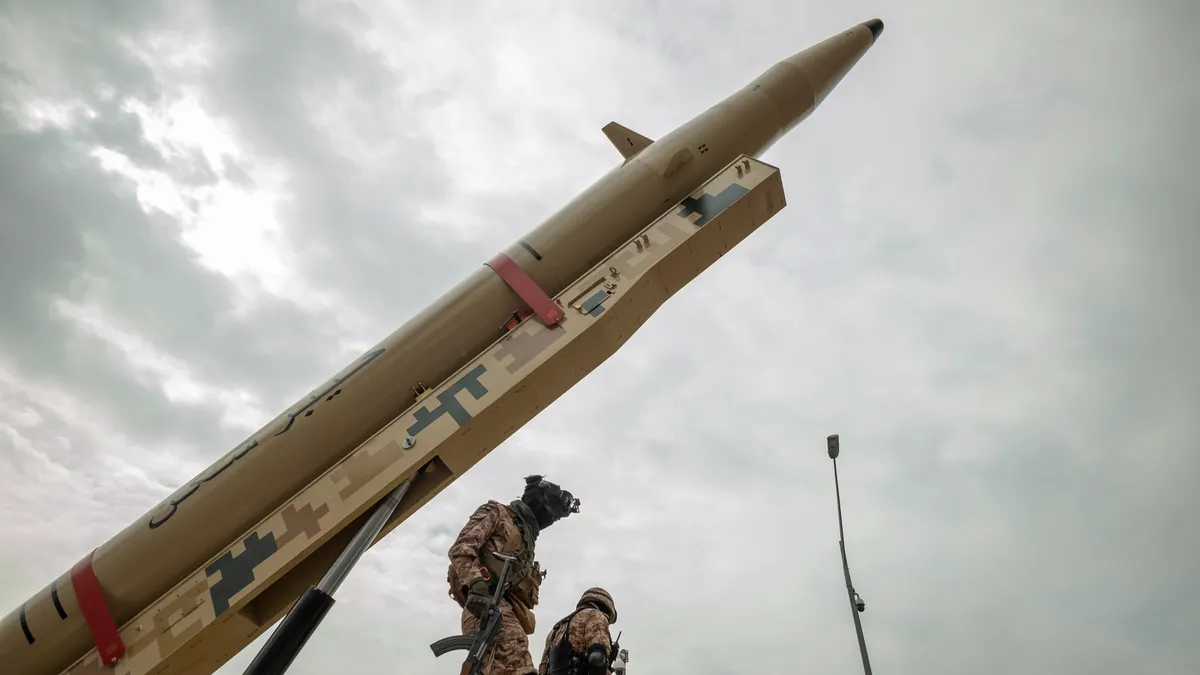
The missile at the center of the disruption is the Kheibar Shekan — a name Iran translates as “Castle Breaker.” With a range of roughly 900 miles, a solid-fuel propulsion system, and a satellite-guided warhead capable of mid-descent course changes, the weapon represents a qualitative jump from the fixed-trajectory rockets that defined regional ballistic-missile threats for the past thirty years. Mounted on road-mobile launchers, the system is exceptionally hard to locate and destroy before it fires, meaning it can endure sustained bombardment campaigns and still deliver its payload.
Strikes That Penetrated the Shield
During the six-month war that President Donald Trump launched jointly with Israel against Tehran, Iranian forces employed the Kheibar Shekan repeatedly against American positions across the Persian Gulf and beyond. The most consequential single event came on July 17, when missiles struck the U.S. Muwaffaq Salti Air Base at Al-Azraq, Jordan, killing three American service members. Iranian government statements, obtained through official channels, explicitly attributed those strikes to Castle Breaker missiles.
The pattern continued into late August. On August 31, an Iranian state-run outlet confirmed that Kheibar Shekan missiles were used to hit both Muwaffaq Salti and the King Hussein Air Base in Jordan. The salvo was a direct response to a U.S. military strike on Iran’s Larak Island the previous night. The IRGC-affiliated Tasnim News Agency stated that the Revolutionary Guard Corps “targeted the technical and maintenance infrastructure as well as fighter-jet bases at the two facilities, causing significant damage.”
Damage was not confined to Jordan. U.S. and allied statements, satellite imagery, and independent reporting indicate extensive destruction at the U.S. Naval Support Activity base in Bahrain — the regional headquarters of the Navy’s Fifth Fleet — and at other key installations. An independent satellite-imagery analysis published by The Washington Post found that Iranian missile and drone strikes damaged or destroyed at least 228 structures and pieces of equipment across at least 15 U.S. military sites in the Middle East over the course of the conflict.
The Defensive Posture Problem
Jonathan Hackett, a former Marine and U.S. intelligence officer who spent two decades working on Iran-related military and intelligence issues from six U.S. embassies, described the operational shock of facing a missile that simply will not hold its planned trajectory. Hackett held positions at the Defense Intelligence Agency, the National Security Agency, and Marine Forces Special Operations Command before retiring in October 2024. He is a fluent Farsi speaker and has followed Iranian military development closely.
“We designed entire air defense systems based on this understanding of what we thought they would do,” Hackett said of Iran’s evolving missile capabilities.
“And now, they’re doing something different. So now you have to change your defensive posture for missile defense in a way that we hadn’t been doing previously. Ever.”
Hackett believes Kheibar missiles were central to the July 17 Jordan strike. He noted, however, that U.S. officials have made independent corroboration difficult by requesting that major commercial satellite providers black out imagery of sensitive American military sites in the region — a step that limits outside analysts’ ability to verify damage assessments.
What the Capability Means for Regional Alliances
The Kheibar Shekan’s 900-mile reach places virtually every major American and allied installation in the Middle East within its envelope. Al Udeid Air Base in Qatar, Prince Sultan Air Base in Saudi Arabia, and Al Dhafra Air Base in the United Arab Emirates all fall inside that radius. For host-nation governments that have hosted U.S. forces for generations, the implication is straightforward: the protective umbrella they relied on is thinner than previously understood.
Conventional ballistic missiles follow a parabolic arc that radar arrays can predict and that interceptor systems can engage at known intercept points. A warhead that maneuvers in terminal descent compresses the decision window for defenders to near-zero and forces them to rely on shorter-range, point-defense layers that were never designed to absorb a full salvo of maneuvering re-entry vehicles. The result, as experts describe it, is that even a partially successful interception campaign leaves enough penetrators to inflict meaningful damage on hardened infrastructure.
Official Accounts and the Question of Success
Top administration officials, including Pentagon chief Pete Hegseth and President Trump himself, have maintained that the U.S. campaign has effectively destroyed Iran’s military capabilities and that American air defenses have succeeded the majority of the time. Iran has vehemently disputed both claims, pointing to the continued operational tempo of its missile and drone forces through the final weeks of the conflict.
The gap between those two narratives is not merely rhetorical. If the satellite-imagery findings are accurate — hundreds of structures damaged across a dozen-plus bases — then the question facing U.S. planners is no longer whether Iranian missiles can reach American positions, but how many will get through on any given night, and whether the layered defenses currently fielded can absorb that volume without catastrophic loss of capability.
For the bases that survived the six-month war, the answer may require a fundamental redesign of how missile defense is layered, timed, and allocated across the Gulf — a redesign that, by the account of former intelligence officers who watched the system being built, was never anticipated when the original architectures were laid down.
Related Reading
Frequently Asked Questions
What is Meet Castle Breaker Iran s missile?
Meet Castle Breaker Iran s missile is the main topic of this guide. The article explains the context, practical details, and next steps readers should understand.
Why does Meet Castle Breaker Iran s missile matter?
Meet Castle Breaker Iran s missile matters because readers are looking for a useful answer, not just a short summary. Good content should match search intent and help them decide what to do next.