
Iran’s World Cup team feted at home with public farewell amid US visa fears
Iran’s World Cup Team Celebrated at Home Amid Political Tensions and Visa Concerns
A Grand Send-Off with Nationalist Symbolism
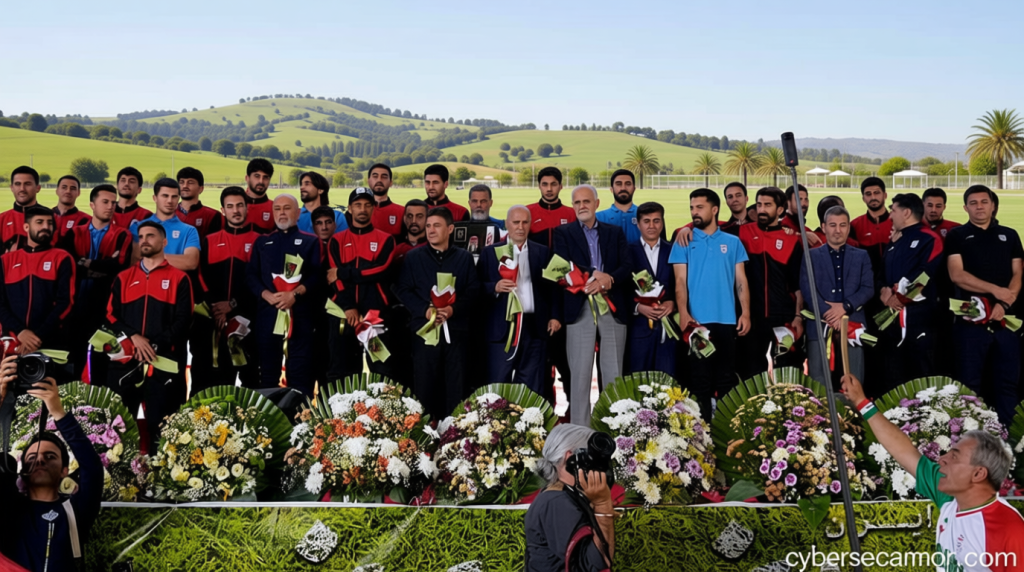
Iran s World Cup team feted – The Iranian national football team recently received a formal farewell in Tehran, drawing a massive crowd that overwhelmed the event’s logistics. Chants of “Death to America” echoed through the stadium, while Hezbollah flags were prominently displayed by supporters in the stands. This ceremony marked a significant moment for the squad, as they prepared for their participation in the 2026 World Cup. The team’s officials and players expressed mixed emotions, emphasizing their resolve to represent the country despite looming uncertainties about their ability to secure US visas in time for the tournament.
Despite the political fervor, the event showcased the team’s unity and pride. The unveiling of their official World Cup kit was a central highlight, symbolizing the nation’s aspirations on the global stage. Some players stepped forward to address the audience, highlighting the sense of patriotism that permeates Iranian football culture. The atmosphere was charged with fervor, as regime-aligned supporters filled the venue, reinforcing the connection between the team and the country’s broader ideological stance.
“This is the most powerful send-off we’ve seen in the last four World Cups. The players embody the people’s will, and the people stand for the nation’s dignity, honor, and strength,” said Mehdi Taj, head of the Iranian Football Federation, during a televised address.
Taj also mentioned that Iranian-American singer Nasrollah Moein, based in Los Angeles, had committed to recording an anthem for the national team. However, Moein quickly refuted the claim, labeling it as a rumor on his Instagram account. The event’s coverage by Mehr News Agency, affiliated with the Islamic Development Organisation, further reflected the political tone, as it edited out footage of Hezbollah flags from its broadcast.
Visa Uncertainty and Diplomatic Challenges
The team’s preparations have been complicated by diplomatic tensions. Since the conflict with the United States and Israel escalated in late February, the question of US visa approvals for players and staff has cast a shadow over their participation. All three of Iran’s group-stage matches are set to take place in the US, yet no visas have been issued, raising concerns about their ability to compete as planned.
Mehdi Taj, who was recently barred from entering Canada during a trip to the FIFA Congress in Vancouver, highlighted the broader implications of the visa issue. The Revolutionary Guards (IRGC) are classified as a terrorist organization in both Canada and the US, and Secretary of State Marco Rubio has stated that individuals linked to the group would face restrictions on entry. Tehran has expressed hope that FIFA will mediate the situation, ensuring the team can proceed without political hindrance.
“We have not yet received any confirmation about the visa process. Our expectation is that FIFA will resolve this within the current timeframe,” said Heydat Mombini, the federation’s secretary-general, at the ceremony.
Mombini added, “FIFA has a responsibility to ensure that all participants have the necessary permissions to attend the tournament. The players deserve the chance to represent Iran on the world stage without unnecessary obstacles.” The situation has been exacerbated by recent reports that the US rejected visa applications for Iraqi footballers, a claim later denied by the White House and the Iraqi Football Association. These developments have heightened anxiety in Tehran, where the football team is seen as a key symbol of national identity.
Disruptions to Preparations and Historical Context
The ongoing conflict has disrupted Iran’s World Cup preparations. Training schedules have been altered, and the team has been forced to rely on internal matches to maintain form. The national coach’s Italian assistant, who had been working with the squad, abruptly ended his contract, citing the political instability as a reason for his departure. These challenges have left the team in a precarious position, with limited opportunities to test themselves against international opponents.
Before the current conflict, the Iranian national team was already under pressure. They had recently lost to Uzbekistan and Russia, prompting calls from sports media, including outlets linked to the Revolutionary Guards, for a foreign manager to take charge. The team’s relationship with Iranians both domestically and abroad remains complex, as their performance has sometimes been tied to political narratives. For instance, during the 2022 World Cup in Qatar, fans in several cities celebrated the team’s losses to England and the US as a form of protest against the government.
The 2026 World Cup represents a critical opportunity for Iran to reclaim its place in global football. However, the combination of visa restrictions and geopolitical tensions threatens to undermine their efforts. While the team’s farewell ceremony underscored their resolve, the uncertainty surrounding their entry into the US looms large. The federation’s hope that FIFA will step in to resolve the issue reflects the broader expectation that international sports organizations will act as neutral arbiters in political disputes.
Looking Ahead: Training and Unfinished Business
In the coming weeks, the team will travel to Turkey for a training camp, where they will also face a warm-up match against Gambia in Antalya on 29 May. The federation has confirmed plans for a second friendly during the camp, aiming to build momentum before the tournament. However, the logistical hurdles created by the visa situation have already forced adjustments to their routine.
While the ceremony celebrated the team’s journey, it also served as a reminder of the challenges ahead. The visibility of Hezbollah flags and the presence of regime supporters highlighted the intertwining of football and politics in Iran. As the nation braces for the World Cup, the players’ ability to compete in the US will be a test of both their resilience and the diplomatic will of FIFA to safeguard the sport’s integrity amid rising geopolitical tensions.
The Iranian Football Federation has remained steadfast in its efforts to secure the team’s participation, framing the issue as a matter of fairness. “Sport should transcend politics, and we hope FIFA will ensure that all teams, regardless of their affiliations, can compete without barriers,” Mombini reiterated. The outcome of this situation will not only determine the team’s performance but also shape the perception of Iran’s role in international sports. For now, the focus remains on the upcoming matches, with hopes that the final resolution of the visa issue will allow the squad to step onto the field with confidence.

