
Putin vows victory in Ukraine and targets NATO at Moscow’s scaled-back parade
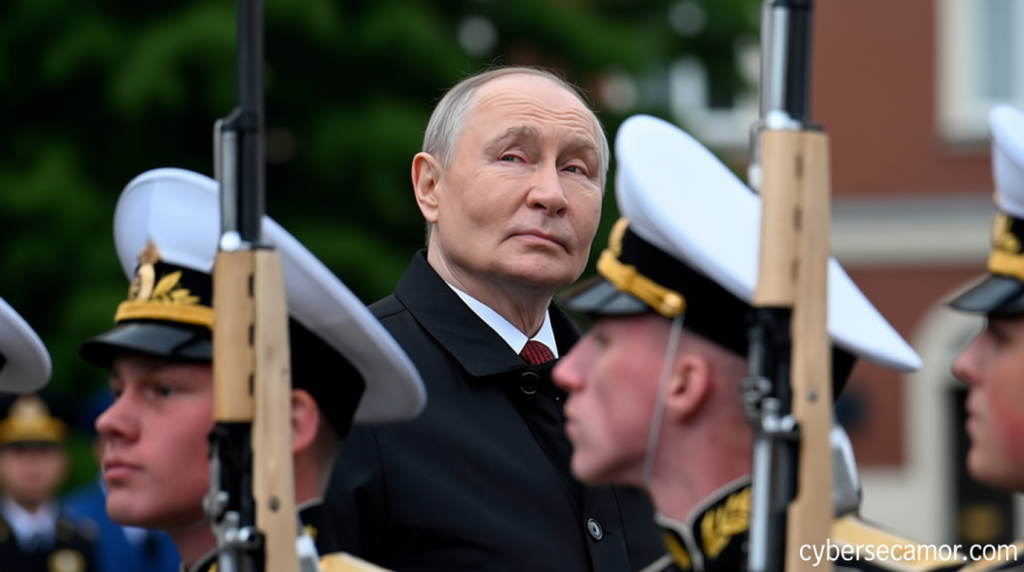
Putin Vows Victory in Ukraine and Targets NATO at Moscow’s Scaled-Back Parade
Putin vows victory in Ukraine and targets – Moscow implemented heightened security protocols as President Vladimir Putin addressed a diminished Victory Day parade on Red Square, commemorating the Soviet Union’s triumph over Nazi Germany in World War II. The event, held under strict measures to prevent disruptions, coincided with a three-day ceasefire brokered by the United States the day prior, which helped alleviate concerns about potential Ukrainian strikes on the Russian capital during the festivities. This year’s ceremony marked a notable departure from past displays, omitting heavy weaponry such as tanks and missiles, with only combat aircraft participating in the traditional aerial showcase.
Putin, who has led the nation for over 25 years, leveraged the occasion to reinforce national pride and assert Russia’s global standing. During his speech, he described the ongoing conflict as a “just” war, framing Ukraine as an “aggressive force” sustained by NATO’s backing. The parade served as a platform to showcase Russia’s military strength, even as its format was altered due to “current operational conditions,” according to officials. The Kremlin emphasized that the decision to exclude heavy arms reflected the evolving military landscape, though the presence of traditional warplanes underscored the symbolic importance of the event.
While the ceasefire agreements were announced, they faced immediate scrutiny. Russia declared a unilateral pause for Friday and Saturday, and Ukrainian President Volodymyr Zelensky imposed a truce from 6 May. However, neither side fully honored the terms, with each accusing the other of continuing attacks. U.S. President Donald Trump’s intervention led to a broader agreement for a ceasefire from Saturday to Monday, including a prisoner exchange. Zelensky, who had previously raised concerns about drones potentially targeting Red Square, issued an executive order to “allow” the Russian celebrations to proceed, temporarily closing the square to Ukrainian strikes.
“We don’t need anyone’s permission to be proud of Victory Day,” remarked Kremlin spokesperson Dmitry Peskov, dismissing Zelensky’s decree as a “silly joke.” The statement highlighted the tension between Russian assertiveness and Ukraine’s strategic concessions, as both nations sought to project influence during the event.
Russian officials warned that any attempt to disrupt Saturday’s ceremonies would result in a “massive missile strike on the centre of Kyiv,” urging civilians and foreign diplomats to “immediately leave the city.” Despite this, the European Union maintained its presence in the Ukrainian capital, refusing to abandon Kyiv under pressure. The scene in Moscow was further amplified by the inclusion of North Korean soldiers in the parade, a first for the event. These troops, according to the announcer’s remarks, played a pivotal role in the “defeat of neo-Nazi invaders in the Kursk region,” a claim that underscored Russia’s reliance on allied forces.
As the parade commenced, Moscow imposed restrictions on mobile internet and text messaging services to ensure public safety. This move, part of a broader campaign to tighten digital surveillance, aimed to minimize the risk of communication disruptions during the celebrations. The escalation of internet controls has sparked growing discontent among citizens, who have occasionally protested the measures, though such demonstrations remain rare in comparison to previous years.
Putin’s address to the parade participants drew parallels between the Soviet past and the present conflict, invoking the sacrifices of the Second World War. The Soviet Union suffered 27 million casualties between 1941 and 1945, a statistic he used to emphasize the enduring spirit of the Russian military. “Victory has always been and will always be ours,” he declared, as columns of troops marched through the historic square. The speech underscored themes of moral fortitude, unity, and the ability to overcome challenges, reinforcing the narrative of Russian superiority in the ongoing war.
The ceremony concluded with a propaganda video sequence that highlighted the Russian military’s “achievements” in Ukraine. The footage depicted scenes of coordinated operations and strategic victories, blending historical references with contemporary battlefields. The visual presentation, accompanied by the official broadcast, served to bolster public morale and international perception of Russia’s capabilities. The absence of tanks and missiles from the parade, however, signaled a shift in how the nation is showcasing its military might, opting instead for symbolic gestures and aerial displays.
International leaders attended the event, including Malaysia’s King Sultan Ibrahim Iskandar, Lao President Thongloun Sisoulith, Kazakh President Kassym-Jomart Tokayev, Uzbek President Shavkat Mirziyoyev, Belarusian President Alexander Lukashenko, and Slovak Prime Minister Robert Fitzo. Their presence underscored the diplomatic significance of the parade, as it provided a stage to project alliances and geopolitical influence. Meanwhile, the inclusion of North Korean troops in the procession reflected broader strategic partnerships, with their contributions highlighted as critical to the campaign’s progress.
Amid the pomp and symbolism, the underlying tensions between Russia and Ukraine remained palpable. The ceasefire, while a temporary reprieve, did little to resolve the conflict’s core issues. As the parade drew to a close, the focus shifted to the future, with Putin reaffirming his resolve to secure victory in the war. His speech, filled with references to historical resilience and modern determination, aimed to unify the nation and justify the continued military campaign. The event, though scaled back, retained its role as a cornerstone of Russian identity, reinforcing the idea that the country’s legacy of triumph is inseparable from its current struggles.
The decision to hold the parade without heavy weaponry also raised questions about Russia’s strategic priorities. While the absence of tanks and missiles might signal a temporary retreat in military display, it could be interpreted as a calculated move to focus on the symbolic power of the event. The combination of military parades, historical echoes, and international support has long been a tool for consolidating public sentiment and international backing. This year, however, the narrative was further complicated by the interplay of ceasefire agreements, drone threats, and the presence of foreign troops, all of which added layers to the celebration’s significance.
As the parade concluded, the focus turned to the next phase of the conflict. Russia’s declaration of a missile strike on Kyiv if the celebrations were disrupted served as a stark reminder of the stakes involved. The event, though a display of unity and strength, was also a strategic moment for Putin to reframe the war as an extension of the Soviet legacy, while simultaneously positioning NATO as the antagonist. The blend of historical reverence and modern aggression in his message reflected the dual purpose of Victory Day: to honor the past and to legitimize the present.
For many Russians, the parade was a moment of reflection and pride, contrasting the sacrifices of the past with the current battle for Ukraine. The absence of heavy arms, while unexpected, did not diminish the ceremony’s impact, as it emphasized the resilience and determination of the Russian military. The event, in its restructured form, highlighted the adaptability of the nation’s military strategies and the continued relevance of Victory Day as a tool for national mobilization and international projection.

