
How many ships are crossing the Strait of Hormuz?
How many ships are crossing the Strait of Hormuz?
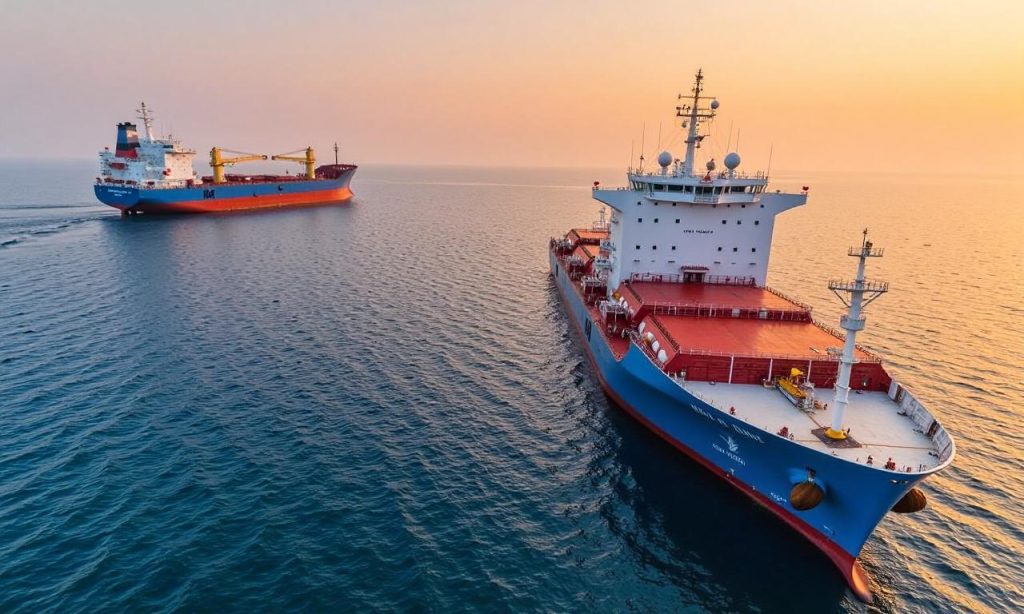
Tracking data from MarineTraffic indicates that four vessels tied to Iran navigated the Strait of Hormuz following the implementation of a US naval blockade. However, two of these ships reportedly altered their course, as revealed by location updates. The US-sanctioned tanker *Rich Starry*, which stated it was transporting cargo, initially moved east from Sharjah, UAE, through the strait overnight but then shifted direction. Similarly, the bulk carrier *Christianna*, which passed eastward after docking at Bandar Iman Khomeini in Iran, also reversed its path.
Iranian Ships Depart Chahbahar Port
Two Iranian-flagged vessels, the cargo ship *Ashkan3* and the container ship *Shabdis*, left the area near Iran’s Chahbahar port—located east of the Strait of Hormuz—after the blockade began. Both traveled over 500km (310 miles) beyond Iranian territorial waters. US Central Command confirmed that six ships complied with orders to turn around, stating “no vessels from Iranian ports breached the blockade.”
“The risk of further escalation to involve direct attacks on ships is growing,” said Jakob Larsen of the Baltic and International Maritime Council, highlighting concerns over potential threats to maritime traffic.
Impact on Global Economy
The blockade has disrupted shipping through the strait, a critical passage linking the Gulf to the Indian Ocean. This has destabilized energy prices and underscored the vulnerability of international supply chains. Before the conflict on 28 February, an average of 138 ships transited the strait daily, according to the Joint Maritime Information Centre. Now, over 800 vessels are reportedly stranded, with fully loaded tankers prioritized for departure.
“You’ve had nearly 800 ships stuck in there for several weeks. Most of them are now loaded with cargo so the priority is going to be to get them out,” noted Richard Meade, editor-in-chief of Lloyd’s List.
Route Shifts and Safety Concerns
BBC Verify’s analysis shows that ships passing through the strait have taken a more northern route, staying close to Iran’s coastline and within its territorial waters. Previously, vessels typically used a central path. Thomas Kazakos of the International Chamber of Shipping raised concerns about sea mines, stating, “We need to make sure that we have clear confirmation that the safety of navigation for the ships and the seafarers are being agreed.”
Iran’s Islamic Revolutionary Guard Corps (IRGC) Navy outlined permitted routes for ships to avoid potential collisions with sea mines, marking the middle of the channel as a “dangerous area.” Meanwhile, US Central Command deployed two destroyers—*USS Frank E Petersen* and *USS Michael Murphy*—to clear the strait of threats.
