
Greek police using masked migrants to forcibly push other migrants back across border
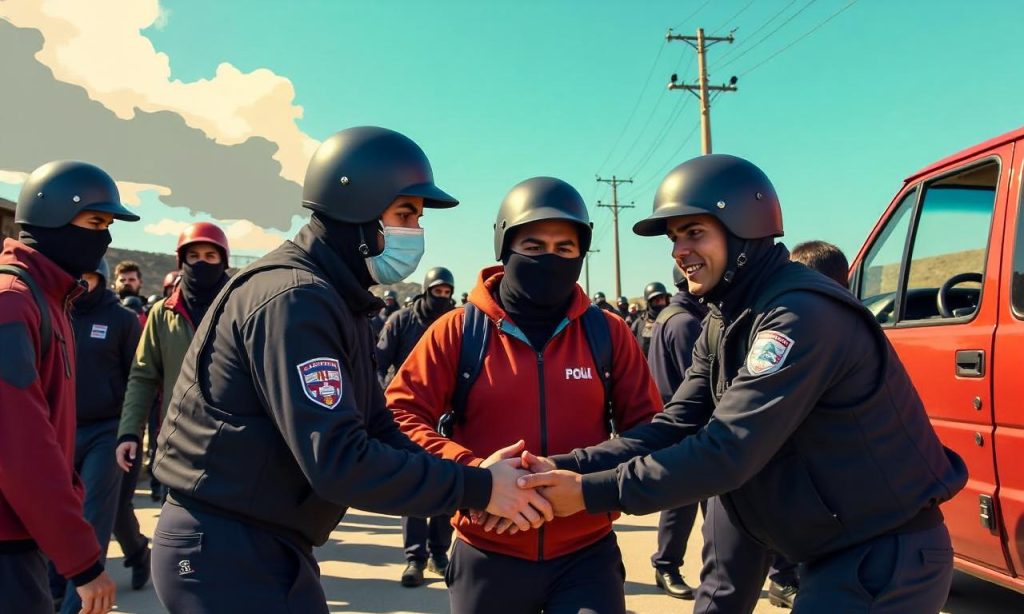
Greek authorities reportedly enlisting migrants as agents to expel others across border
According to comprehensive evidence gathered by the BBC, Greek police have been employing migrants to forcibly repel other migrants back across the land frontier with Turkey. Internal police records obtained by the BBC indicate that senior officials directed and managed the recruitment of these so-called mercenaries. The data suggests that the practice involves mistreatment, with witnesses describing instances of migrants being disrobed, stripped of belongings, beaten, and even subjected to sexual assault.
Claims of mercenaries being used unofficially on the border date back to at least 2020. The Greek prime minister, Kyriakos Mitsotakis, stated to the BBC that he was “totally unaware” of these allegations, while Greek authorities have not yet addressed detailed written inquiries from the BBC. Pushbacks—defined as the return of migrants and asylum seekers to their origin countries without proper legal procedures—are typically regarded as a breach of international law.
In collaboration with the Consolidated Rescue Group (CRG), the BBC launched an investigation in the autumn of 2022. This began after receiving a video allegedly depicting migrants being mistreated by mercenaries. The footage was provided by a smuggler who claimed to have grown disillusioned with his network. Although the BBC has not confirmed the video’s authenticity, it aligns with accounts from other independent sources.
Interviews with migrants, former mercenaries, and police informants, alongside leaked documents and transcripts, reveal that Greece has welcomed over a million migrants since 2015—primarily via sea routes but also through its land border with Turkey. The 200km-long frontier along the Evros River separates Greece’s Evros region from Turkey’s East Thrace. Upon crossing, individuals enter a military-controlled zone featuring surveillance towers.
A police source confirmed that as many as hundreds of people are repelled weekly by mercenaries. They noted, “Every officer stationed in Evros knows pushbacks are occurring.” The mercenaries, themselves migrants from countries like Pakistan, Syria, and Afghanistan, are reportedly motivated by financial incentives and stolen documents that grant access to Greece.
In June 2023, the BBC was shown footage of a group of migrants, who had just entered Evros and sought asylum, being ambushed by masked individuals. A Frontex investigation report concluded that between 10 and 20 “third-country nationals” were following Greek officers’ instructions. These individuals inflicted physical and verbal abuse, including “death and rape threats,” and conducted intrusive body searches. They also restrained migrants, stabbed them, and stole personal items before transporting them back to Turkey, violating EU human rights regulations.
Greek authorities have disputed the presence of these migrants on the day of the incident. This case is among several investigated by the Fundamental Rights Office, which has documented over 100 alleged forced returns in Evros since 2020. Maria Gavouneli, head of Greece’s human rights commission, described the findings as potentially “extremely significant” human rights abuses. While cases have reportedly decreased, dozens of recent incidents involved non-Greek nationals, including those in October 2025.
Frontex has rejected suggestions of involvement in these activities. The agency emphasized that Greece remains committed to border security, with the prime minister reiterating that European leaders are determined to avoid the “massive influx” of migrants seen in the past.
