Argentina players wave banned political banner after World Cup win

Argentina’s Political Banner Sparks Debate Following World Cup Victory Over England
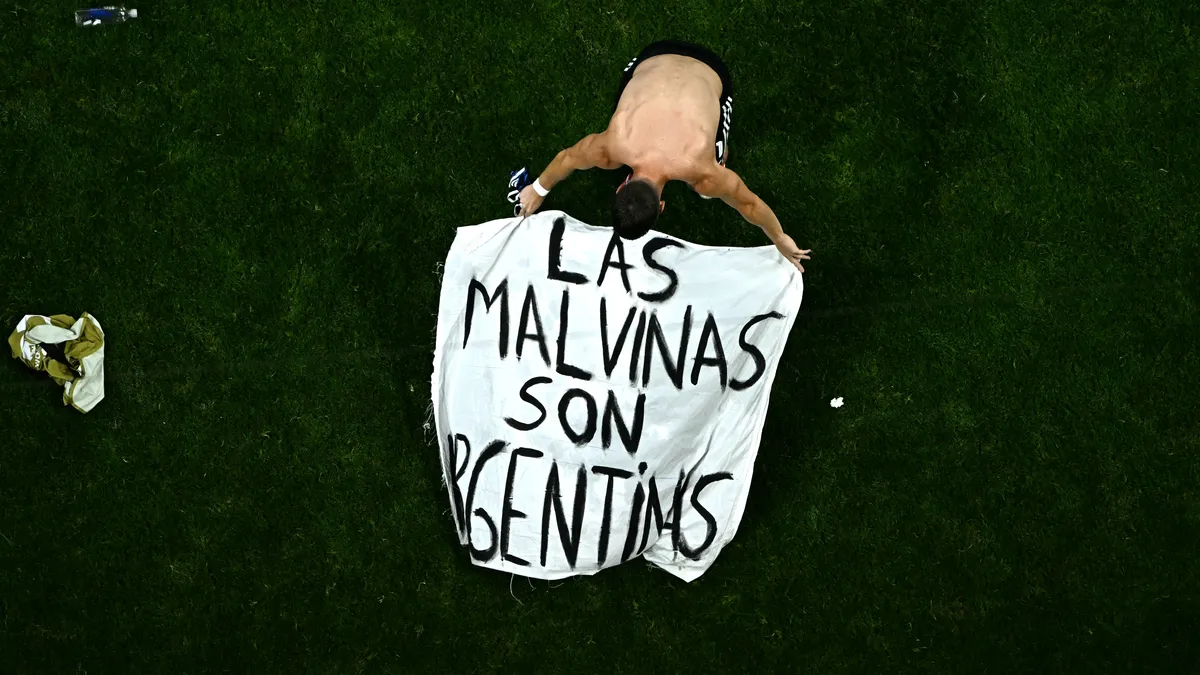
Cybersecarmor.com – In the aftermath of Argentina’s triumph against England during the World Cup semifinals, another wave of controversy emerged when team members displayed a political banner on the pitch. The banner, which proclaimed “the Falklands are Argentine,” directly referenced Buenos Aires’s longstanding territorial claim over the islands, which continue to function as a British Overseas Territory.
This incident occurred despite clear regulations established by both the International Football Association Board (IFAB) and FIFA regarding political expressions during matches. According to the official rulebook, equipment worn or displayed by players must not contain any political, religious, or personal slogans, statements, or images. The regulations extend further, specifying that players must not reveal undergarments displaying such messages, nor advertise anything beyond the manufacturer’s logo.
For any offense the player and/or the team will be sanctioned by the competition organizer, national football association or by FIFA.
Ahead of the highly anticipated match, Argentina’s security minister Alejandra Monteoliva took proactive measures to address potential tensions stemming from the 1982 conflict between the two nations. She announced explicitly that flags and banners referencing sovereignty of the disputed territory would be prohibited from entering the stadium.
The entry of elements that have any type of provocative message, whether of political or racial content, is prohibited. They will not be able to enter flags or posters with that content, Monteoliva told Argentina radio.
FIFA’s Stadium Code of Conduct complements these measures by banning banners, flags, flyers, apparel, and other paraphernalia that are political, offensive, or discriminatory in nature from being displayed inside stadiums.
The Players and the Banner
Despite the pre-match warnings, Argentina players Lisandro Martinez and Giovani Lo Celso were seen celebrating on the field with the banner, which read “Las Malvinas Son Argentinas.” The archipelago carries this alternative name in Argentina, reflecting the nation’s perspective on its territorial identity.
Reports indicated that fans had thrown the banner onto the field for the players to use during their celebration. This spontaneous gesture highlighted the deep emotional connection Argentines maintain with the islands, even as they remain under British administration.
The historical significance of this dispute cannot be overstated. The Falklands conflict erupted when Argentina’s military junta launched an invasion of the islands in 1982. The British fleet subsequently traveled across the Atlantic Ocean and reclaimed the territory following a 74-day undeclared war. The conflict resulted in more than 900 deaths on both sides, leaving a lasting impact on relations between the two nations.
Political Tensions Emerge
On the eve of the World Cup match, Argentina Vice President Victoria Villarruel took to social media with incendiary messages expressing her views toward the English. She declared her refusal to be “politically correct” and criticized what she perceived as British interference in Argentine affairs.
Let’s not be so lukewarm as to believe this is just about football, because while they limit it to football, they keep hanging around in our islands, they stick their noses in our sea, and they cross our territory without permission, they usurp our resources, and the whole world stays quiet about it, Villarruel wrote.
This incident added to a broader pattern of political expression from Argentine figures in recent times. Following Argentina’s victory in the 2024 Copa America, midfielder Enzo Fernandez’s live stream from the team’s bus captured players singing a chant that mocked French players with African heritage. Wesley Fofana, Fernandez’s Chelsea teammate, later described the incident as “uninhibited racism.”
The French Football Federation responded by filing a legal complaint regarding the discriminatory chants. In the wake of this controversy, Argentina’s undersecretary of sports Julio Garro suggested in a radio interview that captain Lionel Messi should issue an apology for the incident, which he believed had “left Argentina looking bad as a country.” However, Garro was promptly dismissed from his position by Argentine president Javier Milei for making this suggestion.
These interconnected events demonstrate how sports venues have become platforms for political expression, with Argentina’s players and officials continuing to use international stages to highlight their territorial claims and cultural perspectives. The banner incident, while seemingly simple, represents the ongoing complexity of international relations, historical memory, and the role of athletics in diplomatic discourse.